Handcrafted in India · Heirloom brass & bronze
The Craft · 9 min read
A morning inside a Jaipur sand-casting workshop.
Before sunrise, the furnace is already lit. We spent a morning with one of the families we work with in Jaipur, watching a plain lump of brass become a bowl by hand. Here is what we saw.
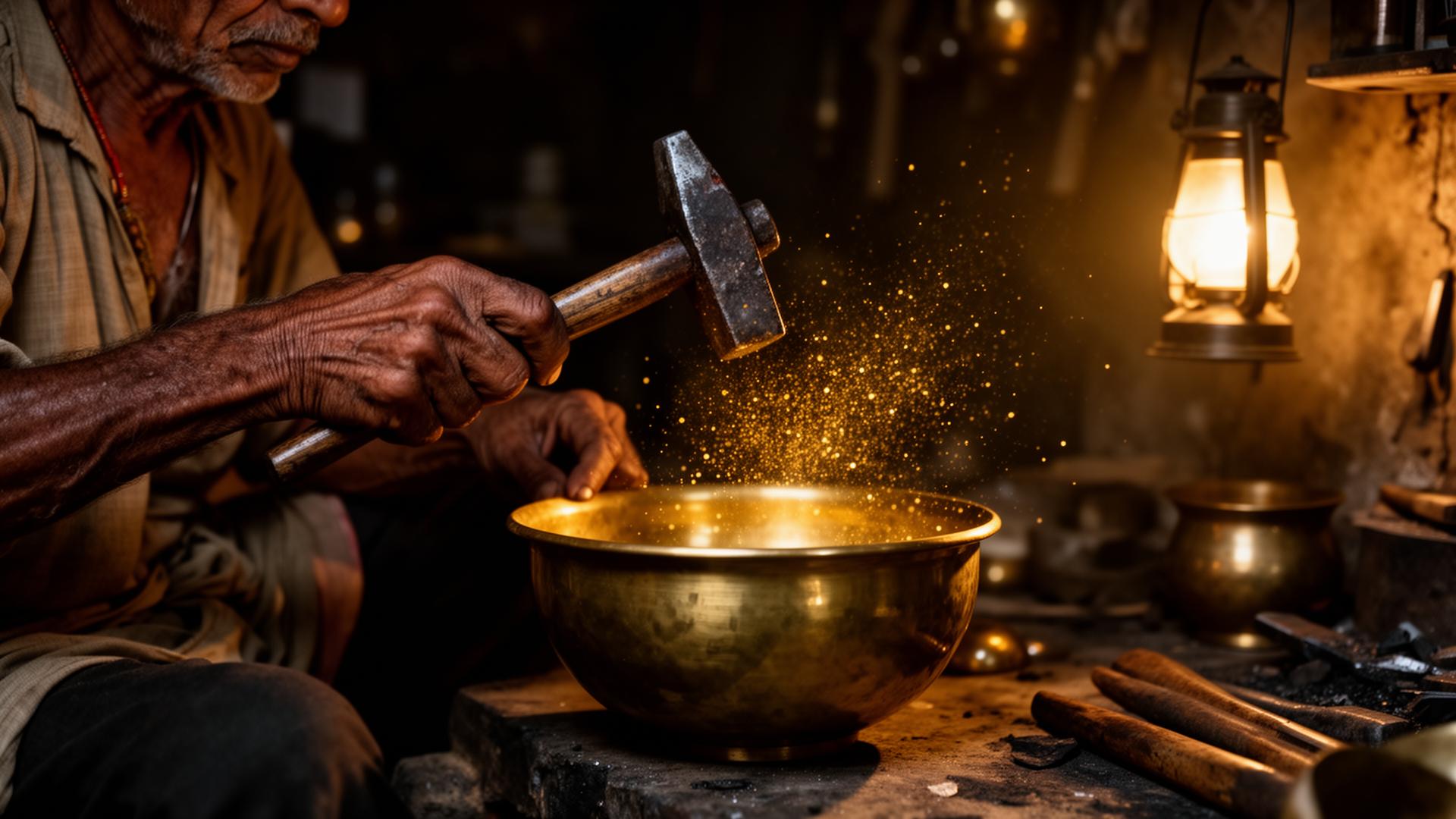
The furnace comes first.
By the time we arrive, the coal-fired furnace has been burning for an hour. Brass scrap is melting in a clay crucible at close to nineteen hundred degrees. The heat is the first thing you feel, long before you see the metal.
The mould is made of sand.
Two halves of a wooden frame are packed tight with fine, damp river sand around a master form. When the halves are parted and the form lifted out, a perfect hollow remains. No two moulds are ever quite identical, which is part of the point.
The pour is over in seconds.
Molten metal is carried across the floor in a ladle and poured into the mould in one steady motion. The first thirty seconds decide everything. Too slow and it sets early, too fast and it spills. The family has done this for three generations, so it looks effortless. It is not.
Then it is broken open.
After cooling, the sand is knocked away and the raw casting tumbles out, black and rough. It is recognisably the piece it will become, but it has hours of work still ahead on the lathe and under the hammer.
Nothing here is rushed.
What stays with you is the pace. Every piece moves through the same hands, in the same order, at the speed the metal allows. It is slow, and it is meant to be.
We left with a bowl still warm from the wheel, and a better understanding of why it costs what it does.
Back to the Journal
The Gilded Haveli
Heirloom brass and bronze, sourced from family workshops across Rajasthan, Tamil Nadu and Uttar Pradesh, made for homes around the world.
Handcrafted in India
© 2026 The Gilded Haveli
Handcrafted in India · Shipped worldwide